

Peptides: Promise, Proof and the Fine Print


There’s a new wellness darling on the block. From weight-loss GLP-1s like Ozempic to “longevity boosters” like BPC-157, experts, influencers and even the FDA are all talking about the billion-dollar peptide industry and what could be the next medical frontier.
“The central debate is evidence versus enthusiasm,” says Artisan Beauté wellness director and emergency medical physician Cristina Del Toro Badessa, MD. Highly specialized treatments promising to shed stubborn weight, repair muscle and even help you live longer suddenly seem within reach. But what’s backed by clinical evidence and what’s wishful thinking marketed as a miracle fix?
Biological Signaling 101: What Peptides Are and How They Work
For over a decade, Emory University chemistry professor and Winship Cancer Institute researcher Monika Raj, PhD, has sought out new ways to create and modify peptides, studied how they interact inside the body and explored cyclic peptides as potential drug molecules. After GLP-1s burst onto the scene two years ago she’s seen her relatively under-the-radar field skyrocket in popularity, and regrettably, misinformation.
Raj explains that at their simplest, peptides are short chains of amino acids that serve as targeted biological messengers in the body. Many peptides, like insulin, are naturally occurring in the body. Secreted by the pancreas in response to high blood sugar from food, insulin sends a localized, precise command to drive glucose into cells as fuel.
Unlike traditional small-molecule drugs that can’t target certain diseases and can often come with huge side effects, synthetic peptides mimic the body’s natural signaling pathways, Raj explains. Synthetic peptides are designed to bind to specific cellular receptors to instruct cells to perform precise physiological functions—such as releasing insulin, suppressing appetite or repairing tissue.
Adding more of something naturally occurring in your body may sound relatively risk-free, but both Badessa and Raj are quick to caution against the “bioidentical fallacy” peptide pushes often espouse. “Natural does not equal harmless. Hormones are natural. Insulin is natural. Cortisol is natural. That doesn’t mean that giving someone more of them, at the wrong dose, for the wrong indication, is safe,” Badessa says. “The same principle applies to peptides. ‘Bioidentical’ primarily describes molecular structure, not a guarantee of safety or effectiveness.”
The Peptide Predicament: The Proven vs. The Wild West
While the future of peptide treatment is certainly worth getting excited about, Raj worries growing interest is outpacing the science. Today, common peptide treatments largely fall in one of two camps: FDA-approved medications supported by robust human clinical evidence; and experimental wellness, longevity and muscle-building peptides backed largely by animal studies or theories about how they might work.
Raj stresses how important human clinical trials are when it comes to safety and efficacy. “Assuming something that works in a cell assay or mice will work the same in humans is a big, big mistake,” she says. Many potential peptide drugs perform well in early laboratory and animal testing only to fail once researchers begin evaluating their safety and efficacy in people.”
She offers up the popular wellness peptide BPC-157 as an example. Lauded for its ability to heal knee pain and aid in joint recovery, preclinical research in mice suggests it may encourage angiogenesis, or the formation of new blood vessels to help injured tissue heal. But blood-vessel growth also plays a role in helping tumors grow and spread. Raj’s concern is not that BPC-157 has been proven to cause cancer; it hasn’t. It is that without adequate human trials, researchers cannot rule out that possibility or identify who may be most vulnerable.
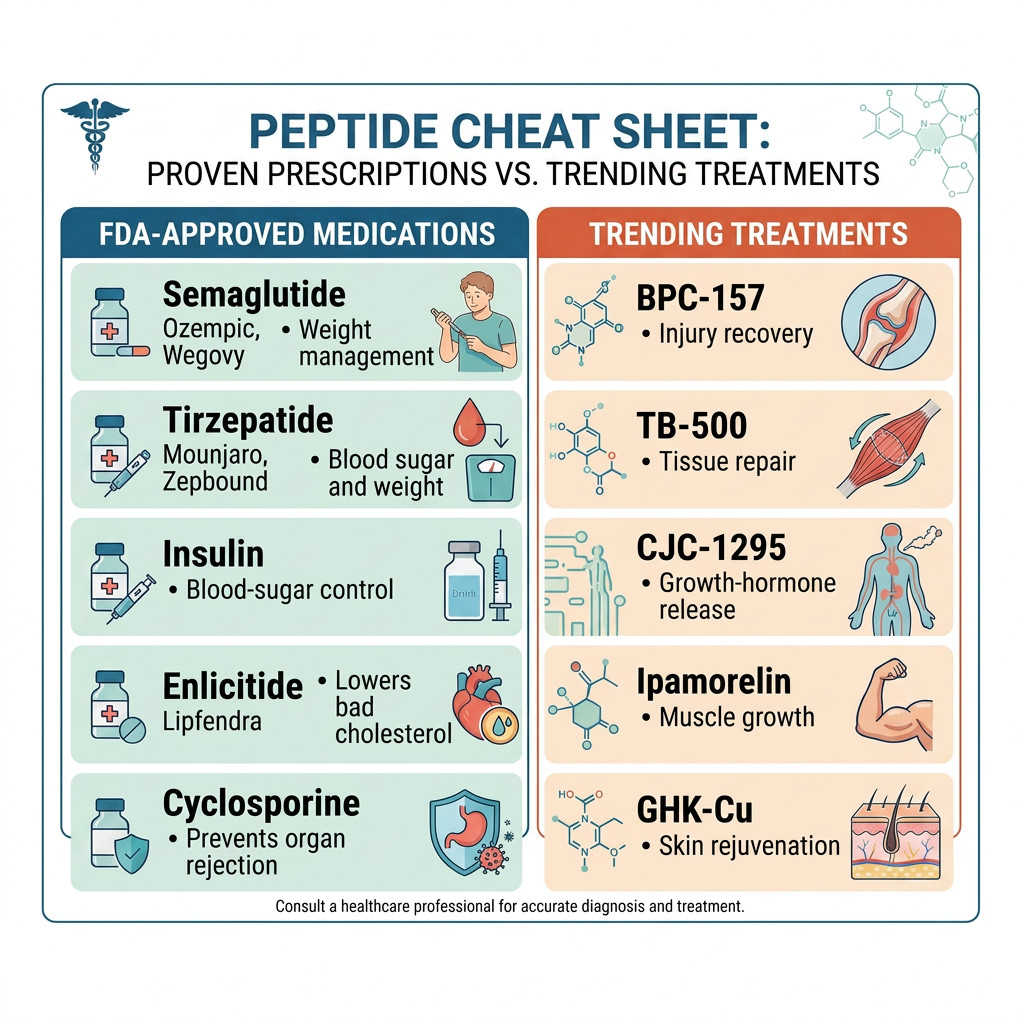 Another concern is immunogenicity, or the possibility that the body will recognize an injected peptide as foreign and mount an immune response. That response can make a treatment less effective or potentially trigger inflammation, hypersensitivity or a serious allergic reaction. The FDA has specifically flagged this risk with compounded BPC-157, injectable GHK-Cu and ipamorelin, noting that peptide-related impurities may make immune reactions more likely.
To Inject or Not to Inject?

So, where does all of this leave the peptide-curious? “The conversation needs to move away from ‘peptides: good or bad?’ and toward a much more useful question: Which peptide, for which patient, for which indication, at what dose, from what source and with what evidence?” Badessa says.
A peptide shouldn’t become a shortcut around the fundamentals. For someone struggling with body composition, for example, Badessa first looks at nutrition, protein intake, resistance training, sleep, insulin sensitivity, thyroid function, hormones, stress and medications. “Ultimately, good peptide medicine shouldn’t feel like a menu of injections,” she says. “It should feel like evidence-based, individualized medicine in which the peptide is only one tool—and sometimes the right answer is not to use one at all.”
Your Peptide Checklist
Questions to Ask Your Provider Before Starting Peptide Therapy
1. Regulatory & Safety
Is this specific peptide FDA-approved for the condition we are treating, and what human trials support its safety?
2. Manufacturing & Purity
Where is this peptide made and manufactured? Can you show me the third-party testing that proves its purity and sterility?
3. Metrics & Monitoring
What exact metric are we hoping to improve? What diagnostics need to be done before, and how often will we check in?
4. Exit Strategy
What is the exact exit strategy? How will we know when we are done?
5. Alternative Options
What happens if I don’t take this peptide? Can I build the biological foundation for healing in any other way?